
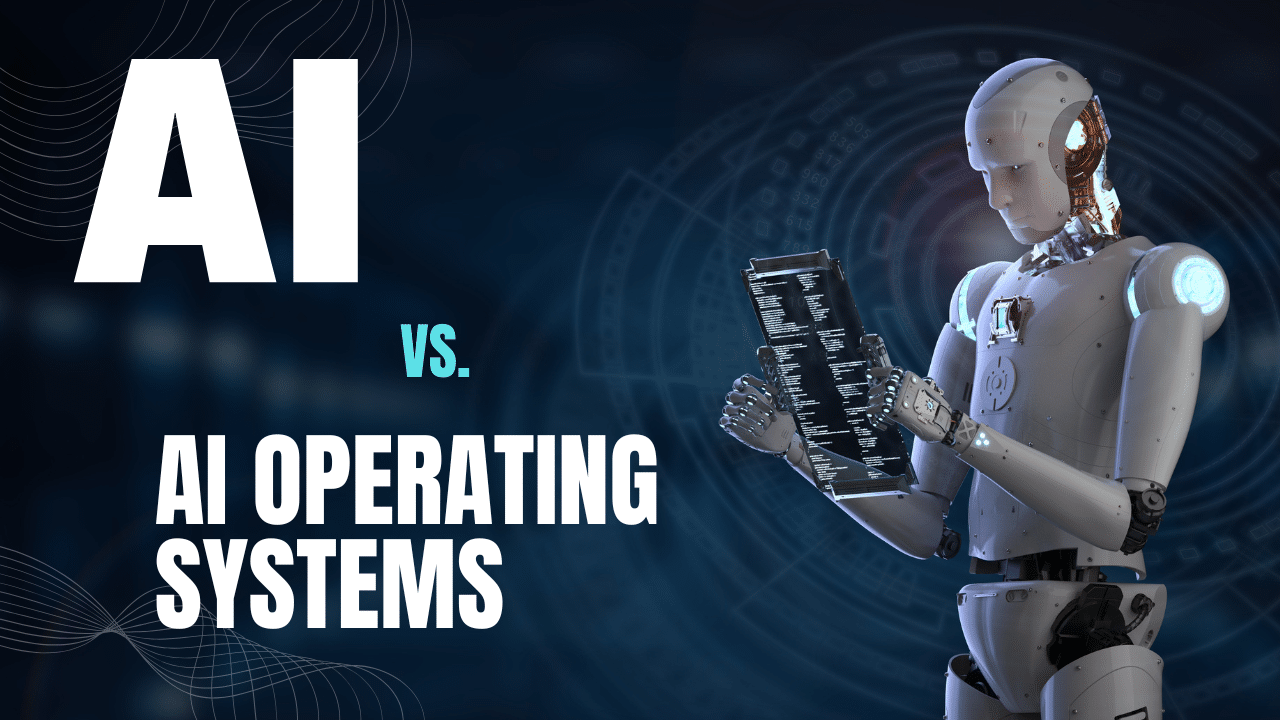
AI TOOLS VS. AI OPERATING SYSTEMS:
Why Your AI Strategy Is Probably Backwards
And why the businesses installing AI operating systems in 2026 will be operationally untouchable by 2027
You opened one Open-Source AI tool for a marketing email. Another for a strategic memo. A third for research. A fourth for social posts. By noon you’ve logged into four different Open-Source AI platforms, re-explained your business context four separate times, and not one of them remembers what the others produced.
You’re not using AI. You’re managing AI fragmentation.
Most businesses think they have an AI strategy. What they actually have is an AI toolkit — a scattered collection of point solutions that don’t talk to each other, don’t remember your business, and reset to zero every session.
The difference between a toolkit and a system is the difference between owning twelve power tools and owning a factory. One builds things one at a time. The other builds things at scale.
The Invisible Tax
Every time you switch between public AI platforms, you’re paying a cost you probably haven’t calculated. Here’s what fragmented AI actually costs a business owner per month:
| The Fragmentation Tax | Monthly Cost |
|---|---|
| Context re-entry across platforms | 8 to 12 hrs/month |
| Inconsistent outputs requiring rework | 6 to 10 hrs/month |
| No institutional memory (resets every session) | 10 to 15 hrs/month |
| Security exposure from public model training | Unquantifiable |
| Total Monthly Drag | 24 to 37 hours |
At a conservative effective rate of $200/hour, that’s $4,800 to $7,400 per month in lost productivity — $57,600 to $88,800 annually. And that’s before counting the strategic cost of decisions made without full context.
The Privacy Problem Nobody’s Talking About
Every time you enter your pricing strategy, your competitive positioning, or your client intelligence into a public AI platform, you are contributing to a model that serves everyone — including your competitors.
Your intelligence trains a system your competitors also access. That’s not collaboration. It’s strategic leakage.
This isn’t a hypothetical concern. In early 2023, Samsung semiconductor engineers pasted confidential source code and internal meeting notes into ChatGPT, using it to fix bugs and summarize discussions, apparently unaware that data was being stored on OpenAI’s servers. The incidents, which occurred within weeks of each other, prompted Samsung to ban public AI tools company-wide. Shortly after, Samsung announced it was developing its internal AI model, Samsung Gauss, built to keep sensitive work off external servers entirely. Private AI infrastructure solves this by design: what you build inside, stays inside.
The Operating System Reveal
The solution isn’t better AI tools. The solution is AI infrastructure.
Every business owner already understands this concept. Microsoft built Windows. Apple built iOS. Neither company gave you a better hammer — they gave you an environment where every tool works together, remembers your behavior, and compounds in usefulness over time.
Businesses need the same thing: an AI operating system.
| AI Tool | AI Operating System |
|---|---|
| Starts from zero every session | Remembers every decision, compounds over time |
| Operates in isolation | Integrates departments, unifies intelligence |
| Public training (your data benefits everyone) | Private infrastructure (your intelligence stays yours) |
| You adapt to it | It adapts to your business |
| Rented access | Owned infrastructure |
| Generic outputs | Your voice, your standards, your decisions |
The gap between toolkit users and operating system users doesn’t narrow over time. It widens — because every day of use adds institutional memory the toolkit user can never retroactively build.
What This Looks Like in Practice
One Operator’s Experience: The $130M Pipeline
One example from the hard money lending space illustrates the shift clearly. I personally have eleven years of closing experience. I was on the development tech test team for CoreBrain and JT1 that built an AI operating system trained on my specific deal criteria, borrower quality signals, asset class comfort zones, risk tolerance, and documentation standards. Before the system, each deal required hours of manual review. My active pipeline held two or three deals at a time.
After deploying the operating system as a pre-term loan committee, deal analysis dropped to less than fifteen minutes. The system flags green, yellow, and red deals with specific reasoning. My pipeline reached north of $130M in Q1 2026 — a 43x increase without a proportional increase in staff or hours.
The key wasn’t the AI itself. It was that the AI was trained on specific judgment, integrated across my workflow, and private to my operation. I wasn’t renting a public tool. I was running infrastructure.
What made this work: institutional memory that compounds, private data that doesn’t train competitors, and a system that replicates the operator’s judgment at scale — not a generic output.
The Multiplier: Replicating Your Judgment at Scale
Here’s the deeper shift that operating systems enable: they don’t just automate tasks. They replicate the thinking behind the tasks.
Every high-performing business owner has the same bottleneck. Their judgment — the experience-built instinct for which deals to take, which clients to prioritize, which risks are acceptable — doesn’t transfer easily. You can hire people, but they don’t think like you. You can write SOPs, but documentation doesn’t capture judgment calls.
The result: a business with a ceiling. And that ceiling is you.
AI operating systems that are trained on a specific operator’s decision patterns — their frameworks, their standards, their voice, their risk thresholds — effectively create a replicable version of that operator’s thinking. Decisions get standardized. Execution stays consistent regardless of who is in the room. Only high-value, novel decisions need to reach the principal.
Inside CoreBrain, we call this “AI Yourself” — a structured AI layer trained not on generic business logic, but on the specific judgment of the operator. To build ours, we interviewed thirty business leaders across eighty-four companies, mapping every key metric, decision outcome, and strategic framework into the system. When that layer is deployed across an organization, the result is institutional leverage: the principal’s thinking is present in every interaction, every output, and every deal review simultaneously.
For real estate investors, capital allocators, and businesses, the implications are significant. Underwriting consistency. Deal screening at volume. Investment thesis enforcement without manual oversight on every transaction.
The Competitive Wedge
Open-Source AI tools are commoditized. If you’re using what everyone else is using, you have competitive parity, not competitive advantage. The edge, if there is one, comes from infrastructure that is private, trained, and compounding.
Every day an AI operating system is in use, the institutional intelligence it holds grows. Deal history, decision patterns, client context, market frameworks — all of it accumulates inside a private system that serves only that business. Competitors using public tools start from zero every morning.
The 18-Month Window
Right now, roughly ninety percent of businesses are still operating with AI toolkits. The ten percent building integrated AI operating systems are accumulating institutional intelligence their competitors won’t fully appreciate until the gap is already compounding.
By the end of 2026, operating-system-level AI will be standard practice in well-run businesses. The organizations that built theirs earlier this year will have a compounding lead in institutional memory that can’t be fast-forwarded. First-mover advantage in infrastructure compounds geometrically and it doesn’t close on its own.
The businesses building operating systems now aren’t just ahead. They’re structurally ahead. That distinction matters.
The Path Forward
The question for business owners reading this isn’t whether AI operating systems will become standard. They will. The question is when you start building yours and whether you build it before or after your competition does.
There are two viable paths. Some organizations have the capital and internal resources to build custom AI infrastructure from the ground up, a process that typically requires $2 to $4M in investment, eighteen to twenty-four months of development, and a dedicated team of AI engineers and business architects. Most don’t and shouldn’t. Several platforms now exist specifically to give mid-market businesses operating-system-level AI without the custom build — onboarding in weeks rather than years, at a fraction of the cost.
Regardless of which path fits your organization, the underlying logic is the same: the businesses that treat AI as infrastructure rather than a toolkit will compound their advantages daily. Those still managing fragmented tools will be running harder to stay in place.
If you’re a business owner, investor, or operator in real estate or capital markets, the immediate next step is an honest audit of how your AI is currently deployed. Ask three questions:
1. Do my AI tools share context with each other, or does every session start from zero?
2. Is my proprietary intelligence staying private, or is it training public models my competitors also access?
3. Is my AI compounding over time — getting smarter about my business specifically — or is it static?
If the answer to any of those is “no” or “I don’t know,” you’re using a toolkit when your business needs an operating system.
Explore how an AI operating system can transform your business:
https://alexburiak.ai/offer-jt1-and-power5
The gap between toolkit users and operating system users doesn’t narrow over time. It widens every single day.













0 Comments